

 Published - Sep 19 2026
 15 min read
 15 views
Two people can be the same age and need completely different facial rejuvenation plans.
One may be most bothered by early jowling.
Another may have an excellent jawline but significant upper eyelid skin.
A third may have very little skin laxity but substantial volume loss through the temples and cheeks.
That is why facial rejuvenation should never begin with the question:
“Which procedure is most popular?”
It should begin with:
“What has actually changed in your face?”
At VG Signature in Tampa, Dr. Vipul Gargya approaches facial rejuvenation as an individualized analysis of anatomy, proportion, tissue position, facial volume, skin quality, neck structure, and the features the patient wants to preserve.
The goal is not to force every face into the same aesthetic.
The goal is to understand the face first, then design the treatment around it.
Quick Answer: How Do You Know Which Facial Rejuvenation Procedure You Need?
Different procedures correct different anatomical problems.
In general:
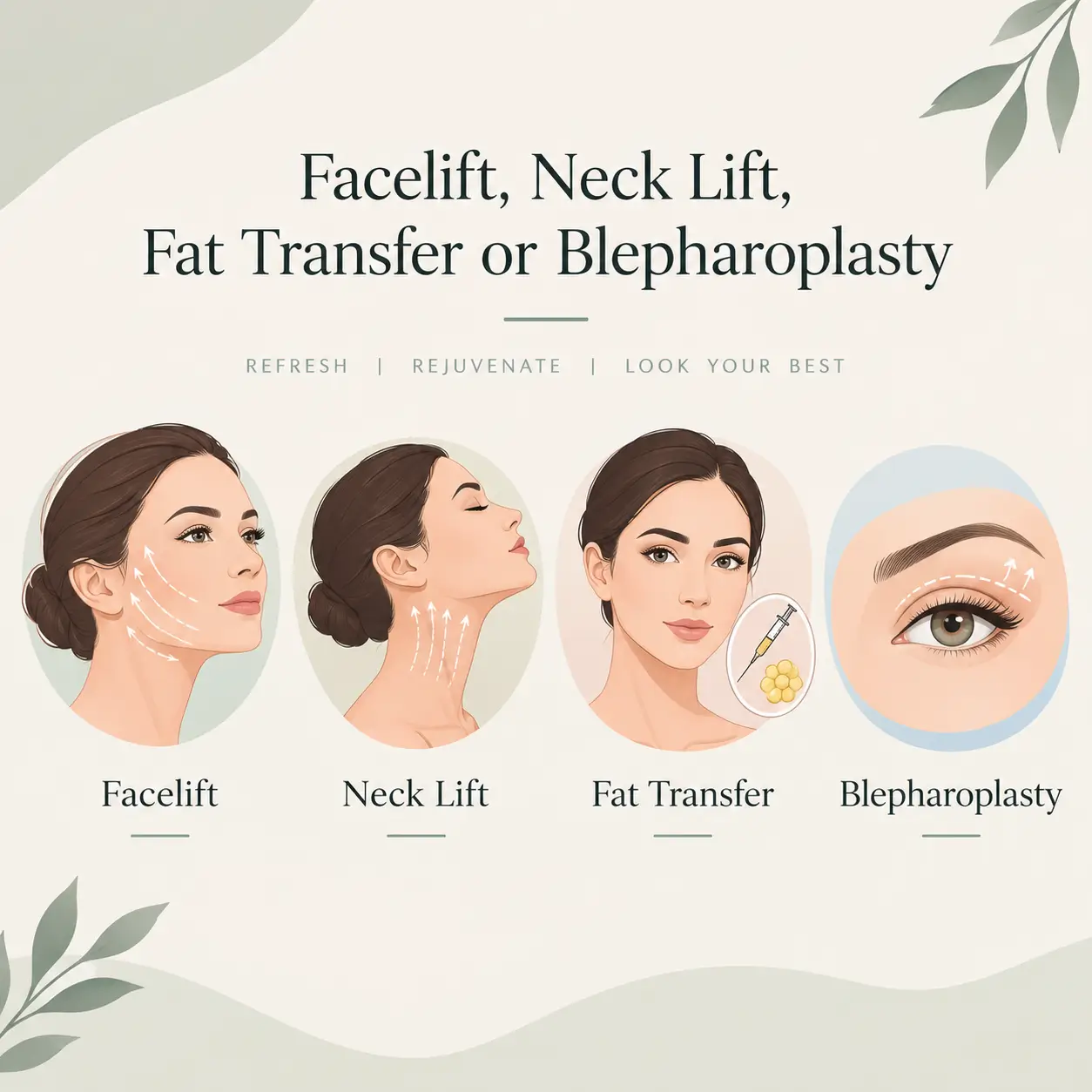
- A facelift addresses facial tissue descent, jowling, and lower-face laxity.
- A neck lift addresses cervical laxity, platysmal banding, neck contour, and the transition between the jawline and neck.
- Facial fat transfer restores volume where aging or weight loss has created true deflation.
- Upper blepharoplasty treats redundant upper eyelid skin.
- A lip lift can restore upper-lip proportions when the cutaneous upper lip has elongated.
- Earlobe reshaping or reduction can address age-related elongation, enlargement, flattening, or distortion.
- Skin-quality optimization addresses surface aging that lifting alone does not correct.
- Hand fat transfer can restore soft-tissue volume when the hands appear disproportionately aged.
Many patients do not need every procedure.
Some benefit from a carefully selected combination
The right plan depends on which anatomical changes are actually creating the aging appearance.
Why Facial Aging Is Different for Everyone
Faces do not age according to a standard template.
Facial aging is influenced by:
- Genetics
- Bone structure
- Skin thickness and elasticity
- Facial fat distribution
- Weight changes
- Sun exposure
- Smoking history
- Hormonal changes
- Previous surgery
- Fillers
- Threads
- Energy-based treatments
- Lifestyle
- Baseline facial asymmetry
This is why two patients in their 50s may look entirely different.
One may have significant neck laxity but good midface volume.
Another may have substantial temple and cheek hollowing with relatively little jowling.
Another may primarily notice upper eyelid hooding.
The treatment plan should reflect those differences.
Your age gives context. Your anatomy determines the operation..
Facial Rejuvenation Should Start With the Problem, Not the Procedure
A common mistake in aesthetic medicine is choosing a procedure before identifying the anatomical problem.
For example, a patient may say:
“I need filler.”
But perhaps the real issue is descending facial tissue.
Another may think:
“I need a facelift.”
But their primary concern may actually be isolated upper eyelid skin or volume loss.
The correct sequence is:
- Identify the concern.
- Determine the anatomical cause.
- Decide which treatment actually corrects that cause.
- Decide whether multiple areas need to be addressed for balance.
- Avoid treating structures that do not need treatment.
This is the foundation of anatomy-driven facial rejuvenation.
When Does a Facelift Make Sense?
A facelift is primarily designed to improve structural facial aging.
Common concerns include:
- Jowling
- Loss of mandibular definition
- Descending cheek or lower-face tissue
- Laxity along the jawline
- Changes in the relationship between the face and neck
Modern facelift surgery does not need to rely primarily on pulling the skin tight.
High-SMAS and deep-plane facelift techniques allow deeper facial tissues to be repositioned so that the skin can be redraped more naturally over the restored structure.
At VG Signature, Dr. Gargya’s CouturaLift™ approach incorporates high-SMAS and deep-plane principles according to each patient’s anatomy.
The objective is not maximum tightness.
It is restoration of youthful facial architecture while preserving identity and natural expression.
When Do You Need a Neck Lift?
The face and neck should not be evaluated separately.
A beautiful jawline depends partly on what is happening underneath it.
Loss of neck definition can involve:
- Loose skin
- Platysmal banding
- Superficial fat
- Deeper cervical fat
- Changes in the cervicomental angle
- Underlying muscular anatomy
- Loss of mandibular definition
For some patients, treating the face without adequately addressing the neck can leave the result incomplete.
A deep-plane neck lift allows the surgeon to directly evaluate the structures contributing to the aging neck and selectively address them when appropriate.
The goal is not an unnaturally carved neck.
It is a cleaner, more youthful relationship between the chin, jawline, and neck.
Facelift vs. Neck Lift: What Is the Difference?
A facelift primarily treats:
- Jowls
- Lower-face descent
- Jawline laxity
- Selected midface changes
A neck lift primarily treats:
- Cervical laxity
- Platysmal banding
- Neck fat when appropriate
- Loss of cervicomental definition
- Jawline-to-neck transition
Many patients have aging in both regions.
For those patients, combining facelift and neck lift surgery may create a more harmonious result than treating either region alone.
When Does Facial Fat Transfer Belong in a Facelift Plan?
Lifting and filling are not the same thing.
A facelift repositions tissues.
It does not replace volume that has genuinely disappeared.
Aging, genetics, or significant weight loss can produce volume loss in areas such as:
- Temples
- Tear troughs
- Cheeks
- Piriform region
- Perioral region
- Jawline
- Chin
For selected patients, autologous facial fat transfer can restore volume using the patient’s own fat.
But fat transfer should not simply make the entire face larger.
Each region should be evaluated individually.
One side may require more volume than the other because natural facial asymmetry is common.
One area may need significant restoration while another needs none.
The objective is three-dimensional facial balance, not generalized fullness.
Facelift vs. Facial Fat Transfer
These procedures solve different problems.
Facelift is best suited to:
- Tissue descent
- Jowling
- Lower-face laxity
- Structural facial aging
Fat transfer is best suited to:
- True volume loss
- Hollow temples
- Deflated cheeks
- Selected under-eye hollowing
- Skeletal or soft-tissue deficiencies
Some patients primarily need lifting.
Some primarily need volume.
Some benefit from both.
Trying to correct tissue descent with volume alone can sometimes make the face heavier without actually restoring the jawline.
Likewise, lifting a significantly deflated face without restoring appropriate volume can leave the result incomplete.
The anatomy tells you which problem is present.
When Does Upper Blepharoplasty Make Sense?
Upper eyelid aging is a separate anatomical issue.
Patients may notice:
- Redundant upper eyelid skin
- Hooding
- Heaviness
- Reduced visible upper eyelid platform
- A tired appearance around the eyes
An upper blepharoplasty removes carefully selected redundant skin while preserving eyelid function and natural shape.
Not every patient needs aggressive fat removal.
In some patients, preserving volume is important to avoid creating an excessively hollow or skeletonized upper eyelid.
The goal should be a refreshed eye that still looks like the patient’s eye.
Does a Facelift Fix the Eyes?
Not directly.
Common concerns can include:
- Early jowling
- Loss of a previously sharp jawline
- Lower-face laxity
- Early neck laxity
- Platysmal banding
- Loss of facial volume
- Hollowing after significant weight loss
- Changes in the relationship between the jawline and neck
- A face that appears heavier or more tired despite otherwise youthful skin
Often, these patients still have relatively good skin elasticity.
Their primary problem is not necessarily old-looking skin.
It may be structural descent beneath the skin.
That distinction matters because different anatomical problems require different solutions.
What Changes Might Make a Younger Patient Consider a Facelift?
A younger patient considering facial surgery often presents very differently from someone with advanced facial aging.
A facelift primarily addresses the mid and lower face.
It does not remove redundant upper eyelid skin.
This is why patients undergoing comprehensive facial rejuvenation sometimes combine a facelift with upper blepharoplasty.
But combination surgery should only be performed when each component addresses a genuine anatomical concern.
The objective is not to add procedures.
It is to create balance.
What About the Brow?
Not everyone who has upper eyelid heaviness needs a brow lift.
The surgeon should distinguish between:
- Redundant upper eyelid skin
- True brow descent
- Natural brow position
- Forehead anatomy
- Orbital anatomy
Automatically lifting the brow because an upper blepharoplasty is being performed can alter facial expression unnecessarily.
Treatment should follow anatomy rather than a template.
Sometimes the best decision is to leave the brow alone.
How Do You Know Whether the Problem Is Skin or Structure?
Facial aging also changes the relationship between the nose and upper lip.
With time, the cutaneous upper lip can appear longer, the distance between the nasal base and vermilion increases, and upper tooth show may diminish.
In the right patient, this can subtly alter facial proportion even when the lips themselves have adequate volume.
A subnasal lip lift can shorten that distance and improve the relationship between the nose, philtrum, vermilion, and teeth.
It is to restore a more youthful upper-lip proportion while preserving the patient’s natural lip shape.
For selected patients, a lip lift can complement facelift, neck lift, blepharoplasty, or facial fat transfer as part of a comprehensive rejuvenation plan.
At VG Signature, the decision is based on facial proportions, upper-lip length, tooth show, nasal-base anatomy, and the patient’s goals.
Small proportional changes can have a disproportionately large effect on how youthful and balanced a face appears.
Earlobes Are Part of Facial Aging Too
The earlobes are easy to overlook, but they can influence how youthful the entire lateral face appears.
With age, earlobes may become:
- Longer or larger
- Stretched
- Deflated
- Flattened against the face
- Distorted by previous earrings or piercings
- Disproportionate after facial rejuvenation
A beautifully rejuvenated face can occasionally make an elongated or distorted earlobe more noticeable.
For selected patients, earlobe reduction, reshaping, or reconfiguration can be incorporated into facial rejuvenation to restore a more balanced relationship between the ear, jawline, and surrounding facial tissues.
This is a relatively small detail, but facial rejuvenation is often defined by small details.
The objective is not simply to make the earlobe smaller.
It is to make it look like it naturally belongs with the rejuvenated face.
Skin Quality Matters as Much as Facial Structure
Facelift surgery can reposition tissues and improve facial and neck contours.
But surgery alone does not correct every aspect of skin aging.
Pigmentation, fine lines, surface texture, photodamage, and overall skin quality require a separate strategy.
At VG Signature, facial rejuvenation therefore extends beyond the operating room.
Each patient’s plan can include a customized pre-procedure and post-procedure skin protocol based on skin type, procedure, healing stage, and individual tolerance.
Depending on the patient, this may incorporate:
- Medical-grade skincare
- Retinoids when appropriate
- Chemical peels
- Pigment management
- Sun protection
- Hydration and barrier support
- Staged postoperative skin treatments once healing permits
The objective is to improve the skin envelope that sits over the rejuvenated facial structure.
A beautifully repositioned face with neglected skin quality is not the same result as a beautifully repositioned face with healthy, refined skin.
Where Facial Fat Transfer Fits Into Skin and Soft-Tissue Rejuvenation
Autologous facial fat transfer is primarily used to restore lost volume and improve three-dimensional contour.
It may also contribute to improvements in the quality and appearance of the overlying soft tissues in selected patients.
At VG Signature, fat is therefore not simply injected wherever the face looks hollow.
It is placed strategically according to:
- Facial volume loss
- Skeletal anatomy
- Soft-tissue thickness
- Facial asymmetry
- Overall facial proportions
- The relationship between the lifted and non-lifted regions
The objective is a face that looks restored rather than filled.
Fat transfer complements structural lifting, but it does not replace thoughtful skin care, resurfacing, or other treatments when those are indicated.
Why the Hands Sometimes Belong in the Same Conversation
The face is not the only place where age-related volume loss becomes visible.
The dorsal hands can develop:
- Loss of subcutaneous volume
- Increased visibility of tendons and veins
- A more skeletal appearance
- Thinning of the soft-tissue envelope
For patients undergoing comprehensive rejuvenation, autologous fat transfer to the hands can sometimes be performed to restore softness and improve the transition over prominent underlying structures.
The goal is not to make the hands look artificially full.
It is to restore a more natural soft-tissue layer so that the hands better match the rejuvenated appearance of the face.
This is especially relevant for patients pursuing comprehensive aesthetic rejuvenation rather than treatment of a single isolated feature.
Why Facial Proportion Matters More Than Treating Individual Features
The face is not a collection of independent parts.
The eye evaluates the entire composition.
That includes relationships between:
- Sideburn position
- Temporal hairline position
- Hair-bearing skin around the ear
- The natural distance between the ear and hairline
A technically successful procedure can still look unnatural if it disrupts those relationships.
A dramatically sharpened jawline paired with an untreated aging neck may look incomplete.
Excessive cheek volume can overwhelm a naturally delicate face.
An aggressive brow lift can change the patient’s expression even if the forehead itself looks younger.
A successful rejuvenation plan therefore asks:
How should each change relate to everything around it?
Why More Procedures Do Not Automatically Mean a Better Result
Comprehensive facial rejuvenation does not mean performing every available procedure.
Quite the opposite.
Restraint is one of the most important aspects of natural aesthetic surgery.
A patient may benefit from:
- Facelift + neck lift
- Facelift + fat transfer
- Facelift + upper blepharoplasty
- Facelift + lip lift
- Neck lift alone
- Fat transfer alone
- Upper blepharoplasty alone
- Earlobe reshaping
- Hand fat transfer
- Skin-quality optimization
- A carefully selected combination
The correct operation is not the longest procedure list.
It is the smallest appropriate combination that fully addresses the patient’s anatomy and goals.
The treatment should match the problem.
Surgical vs. Nonsurgical Facial Rejuvenation
Not every facial concern requires surgery.
Nonsurgical options may be appropriate for:
- Dynamic expression lines
- Skin pigmentation
- Texture
- Fine lines
- Selected volume deficiencies
- Certain early skin-quality concerns
Surgical treatments address different problems.
A facelift and neck lift physically reposition tissues in ways that injectables or skin treatments cannot reproduce.
This does not make one category better than the other.
It means they have different indications.
The right question is not:
“Can I avoid surgery?”
It is:
“Which treatment actually solves the problem I have?”
Sometimes the answer is nonsurgical.
Sometimes it is surgical.
Sometimes the best answer is no treatment yet.
Why Repeated Filler Is Not a Substitute for a Facelift
Filler can be excellent for restoring appropriate volume.
But filler cannot physically reposition descended facial tissue.
When jowling or tissue descent is repeatedly treated by adding more volume, some patients can begin to look heavier or more inflated without correcting the underlying laxity.
That does not mean filler is inherently unnatural.
It means the treatment has to match the anatomy.
Volume loss should be treated as volume loss.
Tissue descent should be treated as tissue descent.
Why Previous Treatments Matter
A facial rejuvenation in Tampa consultation should include a complete history of prior procedures, including:
- Previous facelift or neck lift
- Fillers
- Threads
- Radiofrequency treatments
- Ultrasound-based treatments
- Facial liposuction
- Energy-based tightening procedures
- Prior eyelid surgery
- Previous fat transfer
These treatments may affect:
- Tissue planes
- Fibrosis
- Skin mobility
- Vascularity
- Existing facial volume
- Scar position
Previous treatment does not necessarily prevent future surgery.
But it can change how surgery should be planned.
What Should Be Evaluated During a Facial Rejuvenation Consultation?
A comprehensive facial assessment may include:
Skin
What is the quality, thickness, elasticity, and degree of laxity?
Facial tissue position
Facial tissue position
Facial volume
Where has volume genuinely been lost?
Jawline
Is loss of definition caused by jowling, fat, bone structure, or several factors?
Neck
Is the problem skin, platysma, fat, deeper anatomy, or a combination?
Eyes
Is the concern excess eyelid skin, brow position, volume loss, or another issue?
Upper lip
Has the distance from the nasal base to the upper vermilion become disproportionately long? Has tooth show decreased?
Earlobes
Have the earlobes elongated, enlarged, flattened, or otherwise become disproportionate?
Skin quality
Are pigmentation, photodamage, texture, or fine lines contributing substantially to the aging appearance?
Facial proportions
How do the cheeks, chin, jawline, lips, and neck relate to one another?
Asymmetry
Which natural differences already exist between the two sides?
Previous procedures
Has prior treatment changed the anatomy?
Goals
What does the patient actually want to look different, and equally importantly, what do they want to preserve?
What Makes a Facial Rejuvenation Plan Look Natural?
Natural facial rejuvenation usually depends on several principles working together:
Preserve identity
The patient should still look unmistakably like themselves.
Treat deeper anatomy appropriately
Skin tightening alone cannot correct every form of facial aging.
Use appropriate volume
Avoid both hollowing and overfilling.
Respect facial asymmetry
Perfectly equal treatment does not necessarily produce better symmetry.
Maintain movement
The face should remain expressive.
Avoid unnecessary procedures
Not every structure needs correction.
Treat the face and neck as one composition
Changes should harmonize rather than compete with one another.
Address skin quality
Structural rejuvenation and skin-quality rejuvenation solve different problems and can complement one another.
The result should look natural in ordinary conversation and normal lighting, not only in a carefully selected before-and-after photograph.